Are you ready to find 'gas law homework'? You will find your answers right here.
Table of contents
- Gas law homework in 2021
- Charles' law worksheet with answers
- Gas laws questions and answers pdf
- Gas laws problems with answers
- Boyle's law practice problems worksheet answers
- Gas laws worksheet answer key
- Chemistry gas laws worksheet answer key with work
- Ideal gas law worksheet 14-4 answer key
Gas law homework in 2021
 This picture shows gas law homework.
Charles' law worksheet with answers
 This picture demonstrates Charles' law worksheet with answers.
Gas laws questions and answers pdf
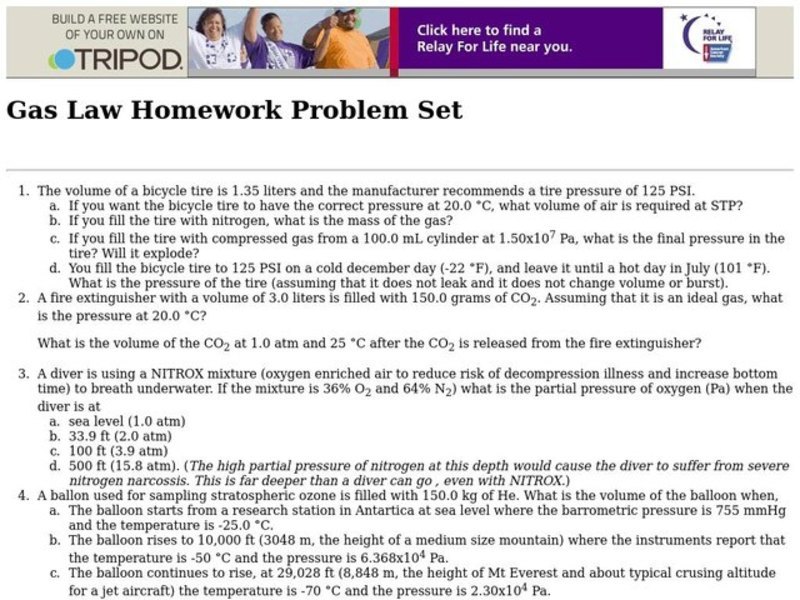 This picture illustrates Gas laws questions and answers pdf.
Gas laws problems with answers
 This picture shows Gas laws problems with answers.
Boyle's law practice problems worksheet answers
 This picture illustrates Boyle's law practice problems worksheet answers.
Gas laws worksheet answer key
 This picture shows Gas laws worksheet answer key.
Chemistry gas laws worksheet answer key with work
 This picture illustrates Chemistry gas laws worksheet answer key with work.
Ideal gas law worksheet 14-4 answer key
 This picture representes Ideal gas law worksheet 14-4 answer key.
How are the laws of gasses related to each other?
Under standard conditions, all gasses exhibit similar behaviour. The variations in their behaviours arise when the physical parameters associated with the gas (such as temperature, pressure, and volume) are altered. The gas laws basically describe the behaviour of gases and have been named after the scientists who discovered them.
Which is the general equation of the combined gas law?
The combined gas law is also known as a general gas equation is obtained by combining three gas laws which include Charle’s law, Boyle’s Law and Gay-Lussac law. The law shows the relationship between temperature, volume and pressure for a fixed quantity of gas. The general equation of combined gas law is given as; PV / T = k
How is the ideal gas law related to the four variables?
This law relates four different variables which are pressure, volume, no of moles or molecules and temperature. Basically, the ideal gas law gives the relationship between these above four different variables. V = volume of gas. T = temperature of the gas.
How to solve the problem of the gas law?
Gas Law Problems 1 (1) By rearranging the equation we can get, P=nRT/V 2 (2) Write down all the values which are known in S.I unit n= 1 R= 8.314J/K/mol T= 20degree celcius= (20+273.15)K=293.15K V=1L=0.001m 3 3 (3) Put all the values in the equation
Last Update: Oct 2021